Why Do I Need B2B SEO? (And What It Costs to Go Without It)

Most B2B companies that try SEO fail. Not because SEO does not work for B2B. It does. Procurement managers search Google before sending an RFQ, and the companies that rank get the calls. B2B companies fail at SEO because they hire generalists who apply the wrong playbook.
If you have spent money on SEO and gotten nothing but PDF reports, you are not alone. Here are the three patterns that cause failure, and what actually works.
Failure 1: The cheap freelancer
What happens: You find someone on Upwork for $500-$1,500 per month. They do keyword research, write blog posts about “5 tips for B2B marketing,” and send you monthly reports with traffic charts. Traffic might increase. Inquiries do not.
Why it fails: The freelancer ranked you for informational keywords that attract students doing research projects and small contractors looking for equipment hire, not the procurement managers who sign contracts. The content was generic because the freelancer did not understand your industry. They wrote about “B2B marketing” because they could not write about load factors, ISO certifications, or RFQ processes.
The cost: $3,000-$18,000 over 6-12 months. Zero new contracts. Plus the time you spent managing someone who needed more direction than they provided value.
Failure 2: The generalist agency
What happens: You hire a digital marketing agency for $2,000-$4,000 per month. They bundle SEO with social media, Google Ads, and “content strategy.” The SEO component is an afterthought, with basic on-page tweaks and a few blog posts per quarter. They focus on vanity metrics (impressions, followers, ad clicks) because those are easier to report than actual leads.
Why it fails: The agency treats your manufacturing company like a restaurant chain. Same keyword research process. Same content templates. Same reporting dashboards. They do not understand that your buyer is a procurement manager with a 6-month evaluation cycle, not a consumer who clicks and buys in 5 minutes.
The cost: $12,000-$24,000 over 6 months. Maybe a traffic increase. No new contracts attributable to SEO. And now you distrust every agency that pitches you.
Failure 3: The DIY attempt
What happens: You read a few SEO articles. Install Yoast on your WordPress site. Ask your office manager or a family member to “update the website.” They add a few pages, start a blog that lasts three posts, and then the effort stalls because nobody has the expertise or dedicated time to execute consistently.
Why it fails: SEO requires sustained, technical execution, not weekend bursts. You need to publish consistently, fix technical issues as they appear, track keyword movements, and adjust strategy based on data. A generalist doing SEO on the side produces generalist results.
The cost: Hundreds of hours of distracted effort spread across months. The website is marginally better but still not generating leads.

The root cause
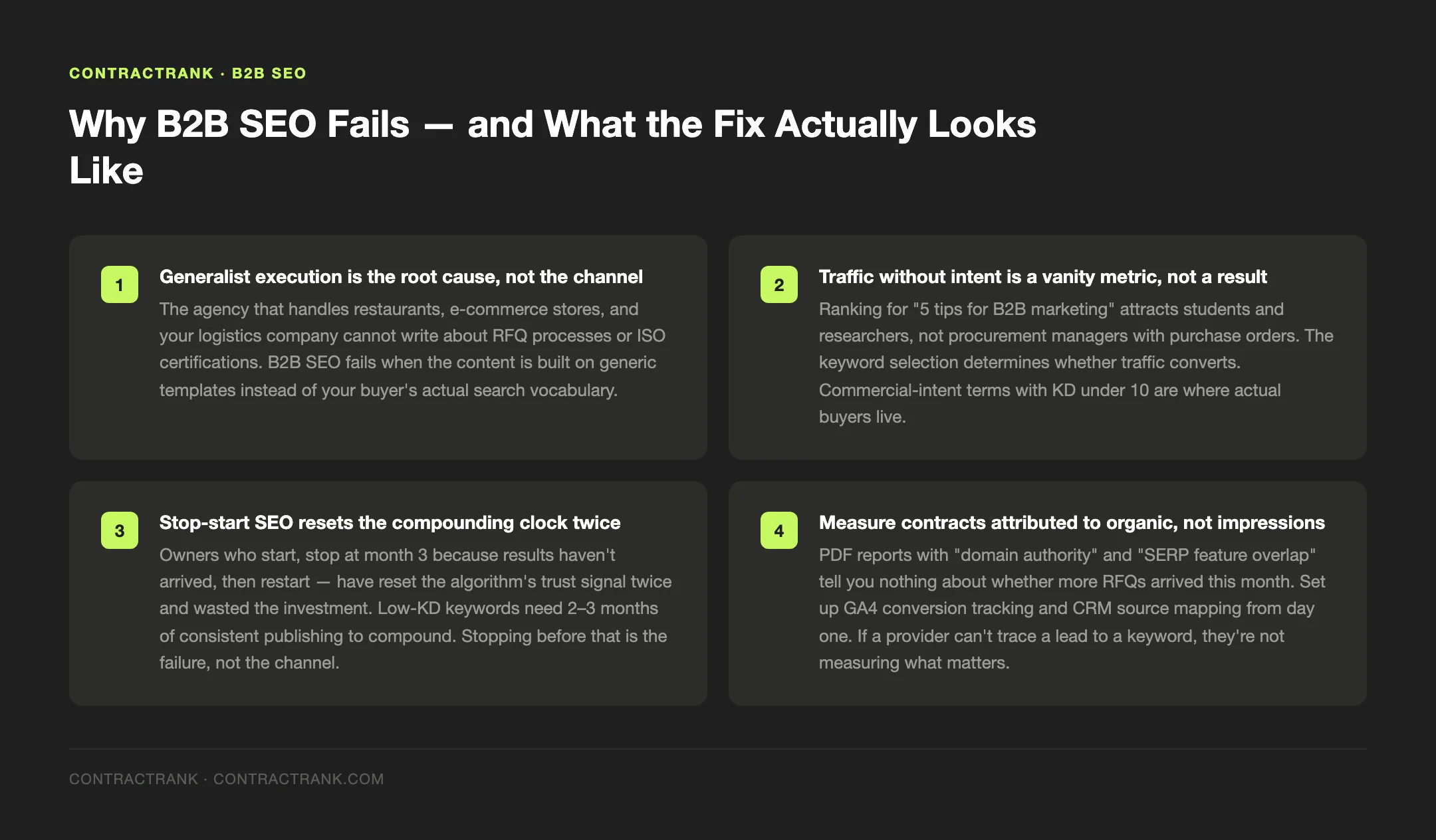
All three failures share the same root cause: generalist execution applied to a specialist problem.
Non-tech B2B companies (manufacturing, logistics, professional services) need content written in their buyers’ language. That means RFQs, spec sheets, compliance requirements, and procurement processes. Not “5 tips for growing your business online.”
They need keywords with commercial intent. Terms that procurement managers actually type when evaluating vendors. Not informational queries that attract students.
And they need an SEO partner who understands that a $200K contract is worth more than 10,000 page views from the wrong audience.
What actually works
1. Industry-specific content. Every blog post and service page targets a keyword that a real buyer in your industry searches. Content is written in their language: load factors for logistics, tolerances for manufacturing, engagement models for consulting.
2. Commercial-intent keywords. The keyword “best b2b seo firm” gets 210 searches per month with a difficulty score of 8. Those are real buyers comparing vendors. That is where the money is, not in “what is B2B SEO” (informational, no buying intent).
3. Transparent pricing and no lock-in. The burned buyer needs to see the price before they engage. $750/month on the website. No call required. No 12-month contract. The results earn the retention, not the contract terms.
4. Consistent execution. Technical audit in month 1. Two blog posts per month from month 2 onwards. On-page optimization. Monthly report. The system compounds. Each piece of content strengthens every other page on the site.
If your previous SEO attempt failed, the problem was almost certainly the partner, not the channel. B2B SEO works when it is built for your industry, not copied from a template.
Read our full B2B SEO guide for a complete walkthrough of how this works. Or learn how to hire a B2B SEO expert who will not repeat the same mistakes.
If you are ready to try a different approach, ContractRank delivers B2B SEO that actually works at $750/month, with no lock-in and no sales calls.

I've spent 11+ years working in B2B marketing across SaaS, ecommerce, and technology. I've helped companies climb to page-1 positions on Google and grow organic traffic significantly across multiple B2B categories. Most SEO focuses on traffic. But B2B growth doesn't come from traffic alone. It comes from showing up when real buyers are searching. ContractRank was built around that idea.