B2B SEO Experts: What to Look For Before You Hire

You have been here before.
An agency pitched you a plan full of jargon. You signed a 6-month contract. They sent PDF reports with traffic charts you could not interpret. After a year and $10,000-$20,000, you had zero new contracts to show for it. The blog posts they wrote, like “5 Tips for B2B Marketing Success,” attracted students and small contractors, not procurement managers with purchase orders.
That was not an SEO failure. That was a specialisation failure. The agency applied the same playbook they use for restaurants and e-commerce stores to your manufacturing company, logistics firm, or engineering consultancy. Of course it did not work.
This guide is for the buyer who has been burned and is ready to try again, but needs to know what to look for this time.
Red flags you already know (but could not name)
If you have worked with a bad SEO provider before, some of these will feel familiar:
Generic content that attracts the wrong audience. The agency wrote blog posts about broad marketing topics instead of the industry-specific problems your buyers actually search for. Traffic went up. Enquiries did not. Because the people reading those posts were not procurement managers evaluating vendors. They were marketing students doing research projects.
Hidden pricing. You had to book a call just to learn what the service cost. When you got the number, it was $5,000-$15,000/month with a 12-month commitment. No breakdown of what that money actually bought. If an agency will not put pricing on their website, ask yourself what else they are not telling you.
Long lock-in contracts. A 12-month minimum commitment protects the agency, not you. If the work is good, you will stay. If it is not, you should be able to leave. An agency that requires a year-long contract before delivering anything is betting you will not cancel even when results do not materialise.
Jargon-heavy reports designed to look impressive. Monthly PDFs filled with “domain authority,” “backlink velocity,” and “SERP feature overlap” tell you nothing about whether the phone rang more this month than last month. Reports should answer one question: are we getting closer to winning contracts through search, or not?
No understanding of your sales cycle. B2B deals take weeks or months to close. A procurement manager does not search Google, click your site, and send a purchase order the same day. Any SEO provider who does not understand that your sales cycle sits on top of the ranking timeline will set expectations that guarantee disappointment.

What real B2B SEO expertise looks like
The difference between a generalist and a genuine B2B SEO expert shows up in five places:
1. Industry-specific content. They write about RFQs, spec sheets, compliance requirements, and vendor evaluation processes, not “how to grow your business online.” The content reads like it was written by someone who understands your industry, because it was informed by how your actual buyers search.
2. Commercial-intent keyword targeting. They target the searches that procurement managers and operations directors type when they are evaluating vendors. Not “what is B2B marketing” (informational), but “custom metal fabrication services” or “third-party logistics provider” (commercial). The difference determines whether traffic turns into leads or just looks good in a report.
3. Transparent pricing and deliverables. You know what you are paying, what you are getting each month, and when to expect results, all before you sign anything. A clear deliverables list (technical audit in month 1, 2 blog posts per month, monthly performance report) beats a vague promise of “SEO services.”
4. Realistic timelines. Low-competition keywords can rank in 60-90 days. High-competition terms take longer. Add your sales cycle. A credible provider will walk you through this math honestly instead of promising “page 1 in 30 days” or hiding behind “SEO is a long-term investment” with no specifics.
5. Results measured in business outcomes. Rankings and traffic are intermediate metrics. The question that matters is: did we get more quote requests, RFQs, or qualified enquiries this month than last month? A real B2B SEO expert ties their reporting to your pipeline, not their dashboard.
7 questions to ask before you hire
These are the questions that separate a specialist from a generalist who learned the word “manufacturing” for your pitch meeting.
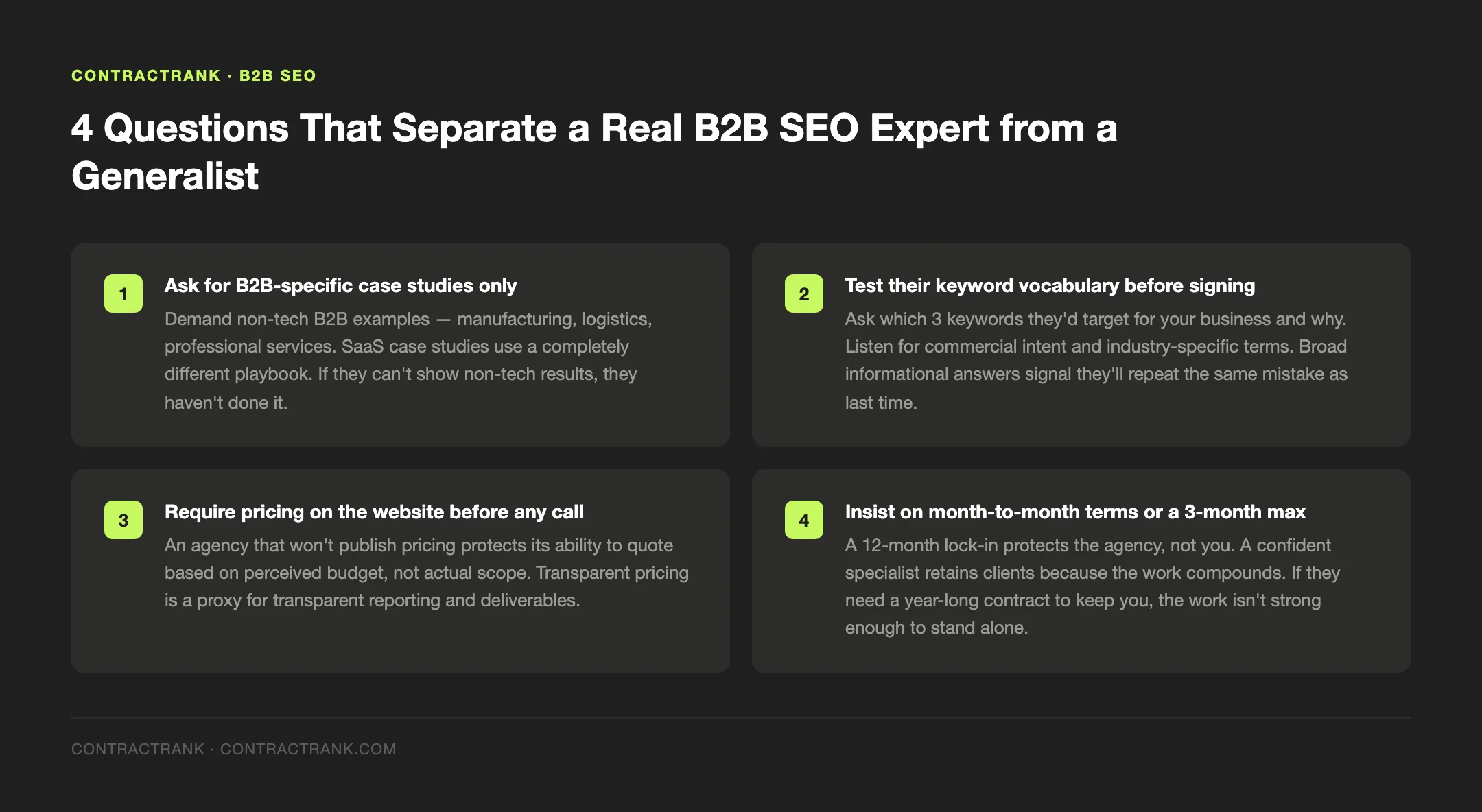
1. “Can you show me B2B-specific results, not SaaS, not e-commerce, not consumer?” If every case study is a software company or an online retailer, the agency does not have experience with long sales cycles, contract-based revenue, or buyers who evaluate through RFQs.
2. “What keywords would you target for my business, and why?” Listen for commercial intent. If the answer is a list of broad informational terms, they are planning the same approach that failed last time. You want to hear specific, industry-relevant queries that your buyers actually type.
3. “What does month 1 look like versus month 6?” A credible provider has a phased plan: technical fixes first, then content, then ongoing optimisation. If the answer is vague or identical for both months, there is no real strategy behind it.
4. “How do you report results, and what metrics matter?” You want plain-English reporting tied to business outcomes: enquiries, quote requests, pipeline movement. If the answer is “we send a monthly analytics report,” ask what is in it and whether you will understand it without a marketing degree.
5. “What is your pricing, and what is included at that price?” If they will not answer this directly, walk away. You have already paid for opacity once. Every dollar of the retainer should be accounted for with a specific deliverable.
6. “What is your minimum commitment, and what happens if I want to cancel?” Month-to-month or a short soft commitment (3 months) is reasonable. Twelve-month lock-ins with early termination fees are not. A confident agency does not need a contract to keep you.
7. “Have you worked with companies in my industry before?” This is not a trick question, but the answer reveals a lot. “No, but here is how we would approach your niche” is an honest answer. “Yes, we work with all kinds of businesses” is a red flag. It means they do not specialise, they generalise.
The pricing landscape: what B2B SEO actually costs
The market has a gap, and it is worth understanding before you make a decision.
$500-$1,500/month: freelancers. Found on Upwork or through referrals. Some are talented. Many apply generic tactics, disappear after a few months, or lack the infrastructure to deliver consistently. This is what most burned buyers tried first.
$3,000-$15,000/month: established agencies. Companies like Stratabeat, Directive, and Elevation B2B operate at this tier. They have teams, processes, and track records. They also have overhead that gets passed to you. For a company doing $1M-$3M in annual revenue, $5,000/month is a serious line item.
$750/month: ContractRank. We sit in the gap between unreliable freelancers and unaffordable agencies. Full technical audit, 2 blog posts per month, monthly reporting. No lock-in. Pricing on the website. See what that looks like in practice with transparent B2B SEO at $750/month.
How to make the decision
You do not need to become an SEO expert to hire one. You need three things:
A provider who speaks your language. If the first conversation is full of jargon you do not understand, that is a communication failure on their end.
Transparent pricing before any commitment. On the website, where you can evaluate it on your own time.
A clear exit if it does not work. Month-to-month or a short commitment. That is how a confident provider operates.
If you want to understand what good B2B SEO looks like, start with our guide to B2B SEO. If you want to understand why your last attempt failed, read why most B2B companies fail at SEO.

I've spent 11+ years working in B2B marketing across SaaS, ecommerce, and technology. I've helped companies climb to page-1 positions on Google and grow organic traffic significantly across multiple B2B categories. Most SEO focuses on traffic. But B2B growth doesn't come from traffic alone. It comes from showing up when real buyers are searching. ContractRank was built around that idea.