How Long Does B2B SEO Take? 60 Days, Not 12 Months

B2B SEO takes 60-90 days to produce first rankings and 3-4 months to produce first organic leads, when you target keywords with a difficulty score under 10. The “6-12 months” answer most agencies give is true for SaaS and consumer search, but wrong for manufacturing, logistics, and professional services, where the competitive keywords sit at KD 5-15. The timeline you have been quoted is roughly twice what the actual math demands.
This breakdown gives you a month-by-month timeline tied to keyword difficulty (a 0-100 score measuring how hard a term is to rank for) instead of the vague year-long estimate agencies use to avoid being held to anything.
Why the “6-12 months” advice is misleading
Most SEO timelines are written for SaaS companies targeting keywords like “project management software” (keyword difficulty 65+) or general search terms with thousands of monthly searches and dozens of well-funded competitors. For those keywords, 6-12 months is optimistic.
Non-tech B2B is a different landscape. Search terms like “best b2b seo firm” have a keyword difficulty of 8. “Top b2b seo company” has a KD of 5. These are terms with real buyer intent (procurement managers and business owners comparing vendors) but relatively low competition because most agencies are chasing the SaaS and consumer markets.
In our experience working with non-tech B2B companies, the timeline is consistently shorter than clients expect coming in, because they have been primed by the generic “it takes a year” answer that agencies use to avoid accountability.

The timeline broken down by keyword difficulty
KD 0-10 (Green tier, low competition) First rankings: 4-10 weeks Page 1: 8-14 weeks First organic leads: 10-16 weeks after the engagement starts
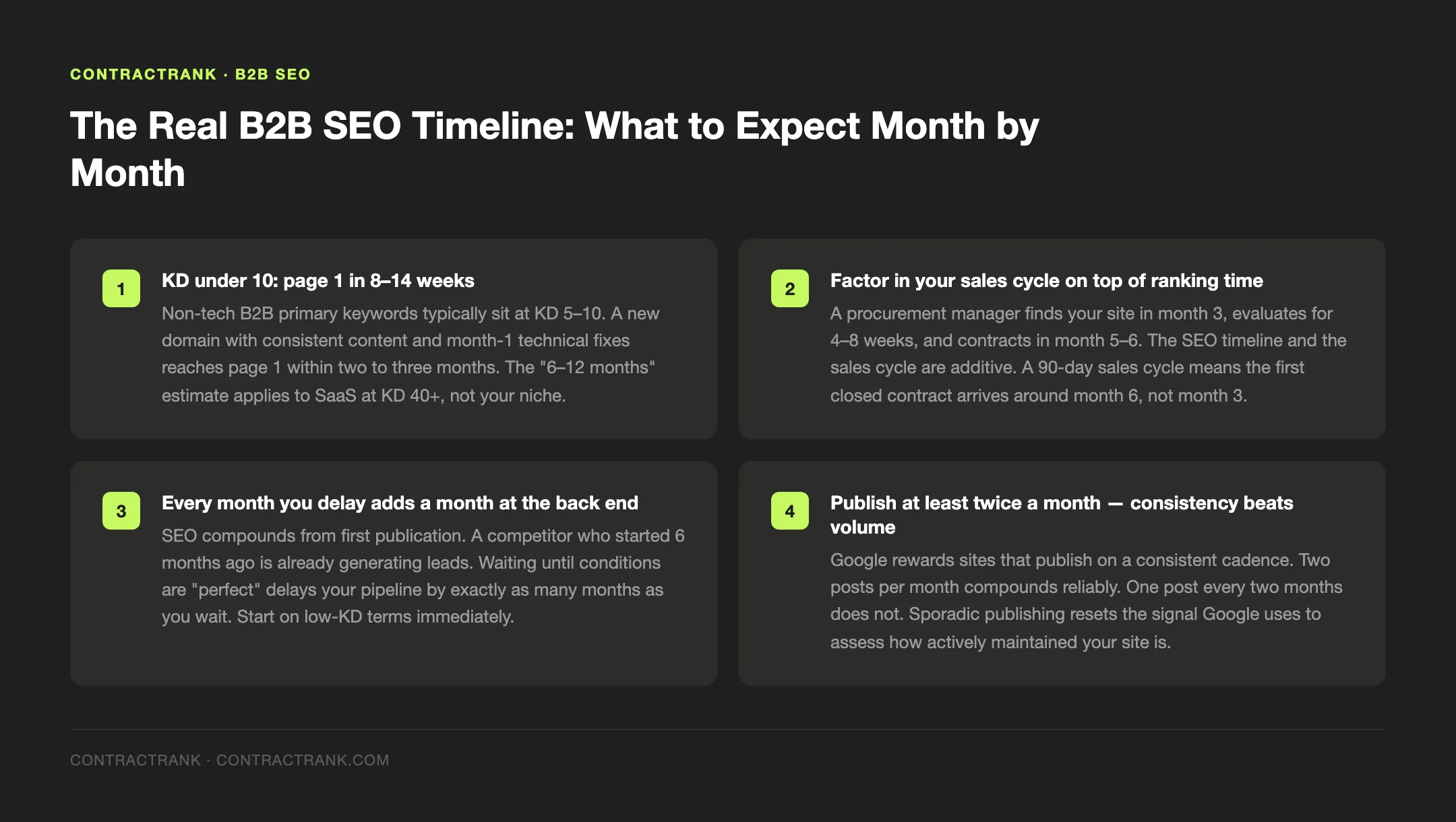
This is the target range for most non-tech B2B primary keywords. “Best b2b seo firm” (KD 8) sits here. A new domain with consistent content and technical fixes applied in month 1 can reach page 1 within two to three months.
KD 10-20 (Amber tier, moderate competition) First rankings: 8-16 weeks Page 1: 12-20 weeks First organic leads: 14-22 weeks
Pillar articles and cluster keywords often sit here. These take longer but build more durable authority. The page 1 position holds longer once established.
KD 20+ (Red tier, high competition) First rankings: 4-9 months Page 1: 6-18 months depending on domain authority and link profile
For new domains and lean budgets, avoid these entirely at launch. Build authority on lower-KD terms first, then target the harder keywords from a position of established topical authority.
What happens month by month
Month 1: Technical audit complete, fixes applied. Google Search Console and GA4 calibrated. First authority article published. No rankings yet. Google is still crawling and assessing the updated site.
Month 2: First blog posts live. Google begins surfacing the site for the target keywords in positions 15-30 (page 2-3). Impressions climbing in Search Console. No leads yet, but visible progress.
Month 3: First page 1 rankings for the lowest-KD terms. Organic traffic from search begins appearing in GA4. First leads arrive for companies targeting KD 5-8 keywords.
Month 4-5: KD 10-15 terms moving toward page 1. Multiple keywords ranking. Organic lead volume increases. For manufacturing and logistics companies where sales cycles run 4-8 weeks, the first closed contract attributable to organic search often arrives in this window.
Month 6: Full reporting cycle complete. 6-month growth assessment. Clear picture of which keywords are performing, which need refreshing, and what the next six months look like.
The B2B sales cycle layer on top
Here is what most SEO timelines leave out: even after you rank, there is a B2B sales cycle before the revenue arrives.
A procurement manager finds your site through organic search in month 3. They read your content. They download the blueprint. They bring it to their team. An evaluation happens over the next 4-8 weeks. If they choose you, the contract is signed in month 4-5. The revenue appears in month 5-6.
The mistake non-tech B2B owners make is waiting until month 1 of the SEO engagement to start their content. The compounding effect of SEO means every month you delay is a month added to the back end of the pipeline. The company that started 6 months ago is already generating leads. The company that starts today reaches the same point 6 months from now.
In our experience, the owners who feel SEO does not work are the ones who started, stopped after 3 months because they did not see leads yet, and then restarted, resetting the clock twice.
What speeds it up
- Low keyword difficulty targets. Choose KD under 10 for your primary keyword and first blog posts. Build from there.
- Consistent publishing. Two posts per month is the minimum. Four is better. Google rewards sites that publish regularly.
- Technical fixes early. Crawl errors (indexing problems that prevent Google from reading your pages) kill rankings before they start. Fix these in month 1.
- Internal linking. Every blog post should link back to the landing page and the pillar article. This distributes authority across the site rather than leaving pages isolated.
What slows it down
- Targeting KD 20+ keywords on a new domain
- Publishing once per quarter and expecting compounding results
- Ignoring technical issues (a misconfigured robots.txt can block the entire site from indexing)
- Producing generic content that does not address buyer-specific queries
For a full breakdown of what B2B SEO costs at each tier and what the investment gets you, read how much B2B SEO costs. For a complete walkthrough of the strategy, see the complete B2B SEO guide.
If you are a manufacturing, logistics, or professional services company that has been waiting to start because SEO takes too long, the timeline for low-competition B2B keywords is shorter than you think. ContractRank B2B SEO services start at $750/month, with no calls, no lock-in, price on the website.

I've spent 11+ years working in B2B marketing across SaaS, ecommerce, and technology. I've helped companies climb to page-1 positions on Google and grow organic traffic significantly across multiple B2B categories. Most SEO focuses on traffic. But B2B growth doesn't come from traffic alone. It comes from showing up when real buyers are searching. ContractRank was built around that idea.