FAQ Rich Results Are Gone: What B2B Service Pages Should Do Instead

For two years, B2B service pages used FAQ rich results (the expanding question dropdowns under blue-link search results) as one of the only reliable ways to outrank Clutch, G2, and other directory listings. That era ended in August 2023. Google retired FAQ rich results for almost everyone. Most B2B sites still have not adjusted.
What changed and when
Google announced the change on August 8, 2023, then Search Engine Land followed up confirming FAQ rich results would no longer display in standard SERPs. The exception is narrow: well-known, authoritative government sites and medical institution sites, think Mayo Clinic, NHS, .gov agencies. Everyone else lost the visual treatment. The schema still validates, the markup still works, but the dropdown no longer appears.
In our experience working with B2B manufacturing and professional services companies, this change hit harder than most niches realised. Most B2B service pages were built specifically to exploit it.

Why B2B got hit harder than most niches
The B2B service page is structurally a FAQ-heavy page. Look at the typical layout: hero with the service name, three or four explanatory paragraphs, then 8-15 questions buyers always ask before signing a contract. “Do you offer rush orders?” “What is your minimum quantity?” “Are you ISO certified?” That format exists because it mirrors how a procurement manager actually reads a vendor’s site.
Two things made FAQ rich results disproportionately valuable for B2B service pages:
1. Directory listings dominated the SERP. Searches like “industrial CNC machining services” or “B2B logistics audit” return Clutch, G2, Capterra, ThomasNet, and trade-association directories in the top five positions. A directory listing is functionally bigger than a normal organic result. It’s a page of vendors, not one vendor. FAQ rich results were one of the few features that let a single B2B vendor’s page expand vertically and push directory results below the fold.
2. FAQ schema demands no engineering work. Most B2B sites are on WordPress with Yoast or Rank Math, both of which auto-generate FAQ schema from a content block. A non-technical B2B founder could ship FAQ schema in an afternoon. Compare that to Service or LocalBusiness schema, which requires either a developer or a careful Yoast configuration.
So B2B sites leaned on FAQ schema. And then Google removed the SERP benefit. What’s left for B2B owners is real, but it’s a different game.
What B2B sites should actually do now
There are three moves. None of them are “remove FAQ schema.” Keep it. The reason is just different now.
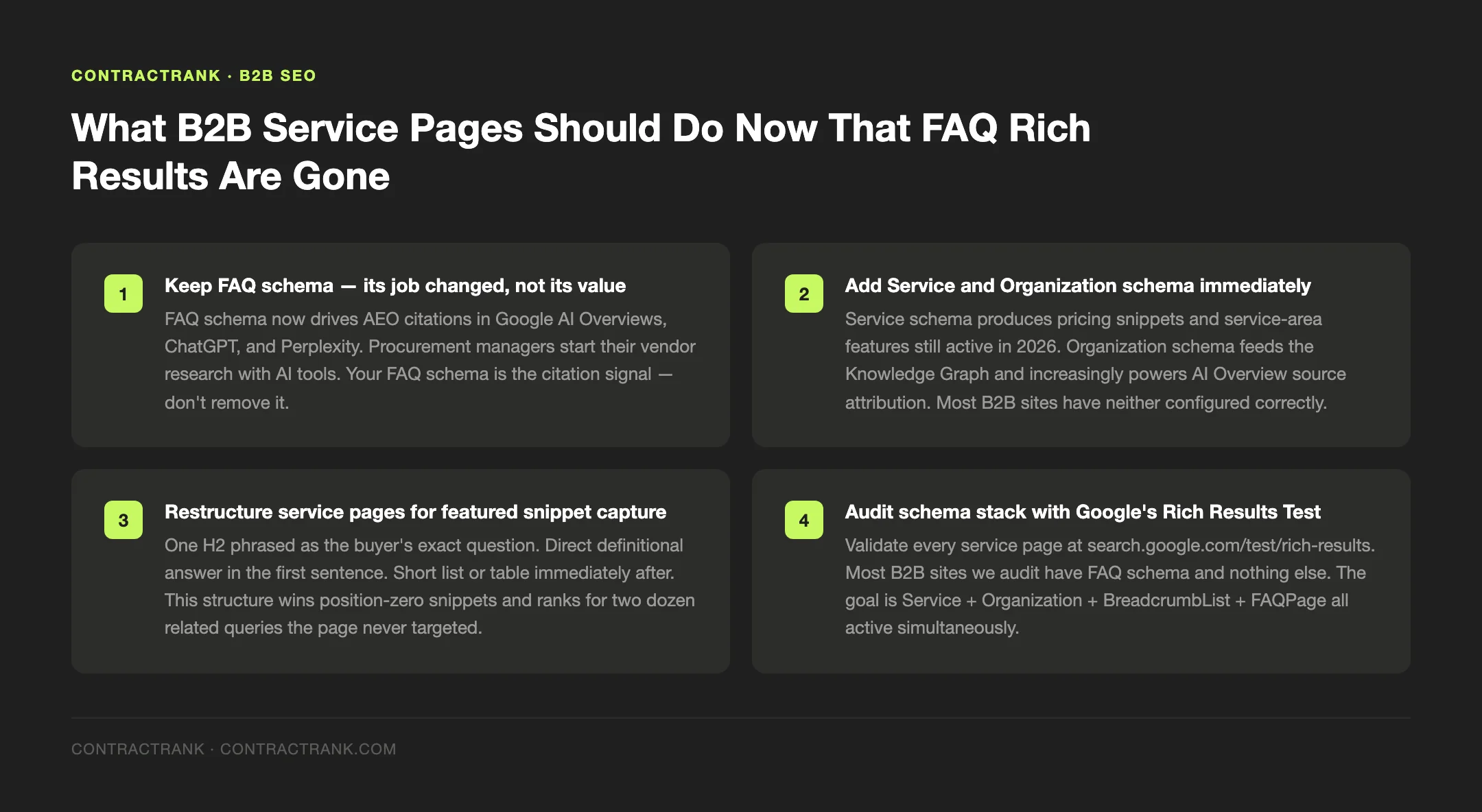
1. Keep FAQ schema for AEO citations, not SERP visibility
AI Overviews (Google’s AI-generated answers above the blue links), ChatGPT search, and Perplexity all consume structured data when picking which sources to cite. FAQ schema explicitly labels question-answer pairs in a format AI systems can extract cleanly. For B2B research-phase queries, where buyers ask “what does ISO 9001 actually require” or “what is the difference between offset and digital printing for packaging,” getting cited in an AI answer is now the highest-CTR placement on the page.
In practice for B2B, what we consistently see is that the buyer’s first three or four searches are research-phase. They use AI tools. Then they switch to vendor-evaluation searches and use Google directly. FAQ schema captures the first half of that journey. Don’t remove it.
2. Reclaim SERP real estate via Service, Organization, and BreadcrumbList schema
Service schema, Organization schema, and BreadcrumbList schema are still actively driving rich SERP features in 2026. Service schema produces pricing snippets and service-area enhancements. Organization schema feeds the Knowledge Graph, which is what produces the company panel on the right of a branded search and increasingly powers AI Overview source attribution. BreadcrumbList replaces ugly URL strings in the SERP with a clean hierarchy.
For B2B sites, the order of priority is:
| Schema type | What it does in 2026 | Effort |
|---|---|---|
| Organization | Site-wide entity establishment, Knowledge Graph eligibility | Low (once, sitewide) |
| Service (per service page) | Pricing snippets, service-area features, AI source signals | Medium (one per service page) |
| BreadcrumbList | Clean SERP path display | Low (automatic with most CMS plugins) |
| FAQPage | AEO citation eligibility | Low (keep what you have) |
| Article | Rich result eligibility for blog content | Low (automatic with most blog setups) |
The compounding move is Service + Organization. Most B2B sites we audit have one or the other, almost never both correctly configured.
3. Restructure service pages for featured snippets (they didn’t go away)
Featured snippets, the boxed answer at position zero, are still alive and still pull strong CTR. Google quietly increased their prominence after the FAQ retirement. The structural pattern that wins them on B2B service pages:
- One H2 phrased as the buyer’s exact question
- A direct definitional answer in the first sentence
- A short list or table immediately after
A real example. The buyer search is “what does CMMC compliance cost.” Most B2B service pages bury this inside a 600-word paragraph about why compliance matters. The page that wins the snippet leads with “CMMC compliance costs $35,000 to $250,000 depending on your maturity level.” Then a three-row table. Then the explanation. The exact same content reorganised, and that page ranks for two dozen related queries it never targeted.
If your B2B service pages still rely on a long FAQ block at the bottom to do the heavy lifting, this restructure is where to start.
What this means for your service page audit
Three things to check on every service page this week:
- Service schema present and complete? Validate at Google’s Rich Results Test. Most B2B sites we audit have FAQ schema and nothing else.
- Featured snippet structure on the top buyer questions? One H2 per question, direct answer first sentence.
- Organization schema sitewide? Single source of truth in your site footer or header.
The B2B SEO playbook changed quietly in 2023 and most owners are still operating on the old one. The fix isn’t dramatic. It’s surgical. Read our pillar guide on B2B SEO for the full architecture, or look at how we approach B2B technical fixes when we audit a service page from scratch. For the broader picture on other patterns we see B2B sites get wrong, the FAQ-only schema strategy is one of the top three.
If your B2B service pages still depend on FAQ rich results for visibility, we can audit them and fix the schema stack in the first month. That’s the first thing we do for every ContractRank engagement.
FAQ
Should I remove FAQ schema from my B2B service pages? FAQ schema now functions as an AEO asset for B2B service pages. It labels question-answer pairs in a format Google AI Overviews, ChatGPT, and Perplexity can extract and cite, which is exactly where procurement managers run their research-phase queries before vendor evaluation. Leave the schema in place. The SERP dropdown is gone, but the citation pathway is active.
Did Google retire HowTo schema too? Yes. HowTo rich results were removed entirely from desktop SERPs in September 2023, narrowed on mobile shortly after. Same logic applies. Keep the schema for AI citation, don’t expect SERP visibility from it.
Which B2B sites still qualify for FAQ rich results? Effectively none in the commercial B2B space. Google limited the exception to authoritative government and medical institution sites. A B2B manufacturer, logistics firm, or professional services consultancy will not qualify, regardless of domain authority.

I've spent 11+ years working in B2B marketing across SaaS, ecommerce, and technology. I've helped companies climb to page-1 positions on Google and grow organic traffic significantly across multiple B2B categories. Most SEO focuses on traffic. But B2B growth doesn't come from traffic alone. It comes from showing up when real buyers are searching. ContractRank was built around that idea.