Best B2B SEO Agency: 7 Criteria That Actually Predict Pipeline

The best B2B SEO agency for your business is the one that understands your sales motion, not just SEO mechanics. For non-tech B2B (manufacturing, logistics, professional services, industrial), that’s a smaller list than the SaaS-heavy “best of” articles suggest.
Why most “best B2B SEO agency” lists miss non-tech B2B
Open any “best B2B SEO agency 2026” listicle and read the agency descriptions. Almost every one names B2B SaaS as the focus. The case studies are HubSpot, Notion, ClickUp, and Salesforce-adjacent SaaS companies with 14-day trial cycles, freemium funnels, and product-led-growth playbooks.
Manufacturing, logistics, and professional services don’t sell that way. The buyer is a procurement manager or operations director researching vendors 4-6 weeks before issuing an RFQ. The contract value is $50K-$500K. The sales cycle is 90-180 days, not 7. The content that converts is spec-driven, capacity-aware, and written in the procurement vocabulary the buyer already uses.
A B2B SaaS agency applying its playbook to a custom fabrication shop will produce content that ranks for “5 tips for B2B marketing” and converts zero contracts. We’ve audited non-tech B2B sites where the previous agency wrote 60 blog posts in 12 months and not one targeted a procurement-intent query. That’s the gap most listicles don’t show.

The 7 criteria that actually predict pipeline
These matter more than agency rankings, awards, or case study count. Test every shortlisted agency against all seven.
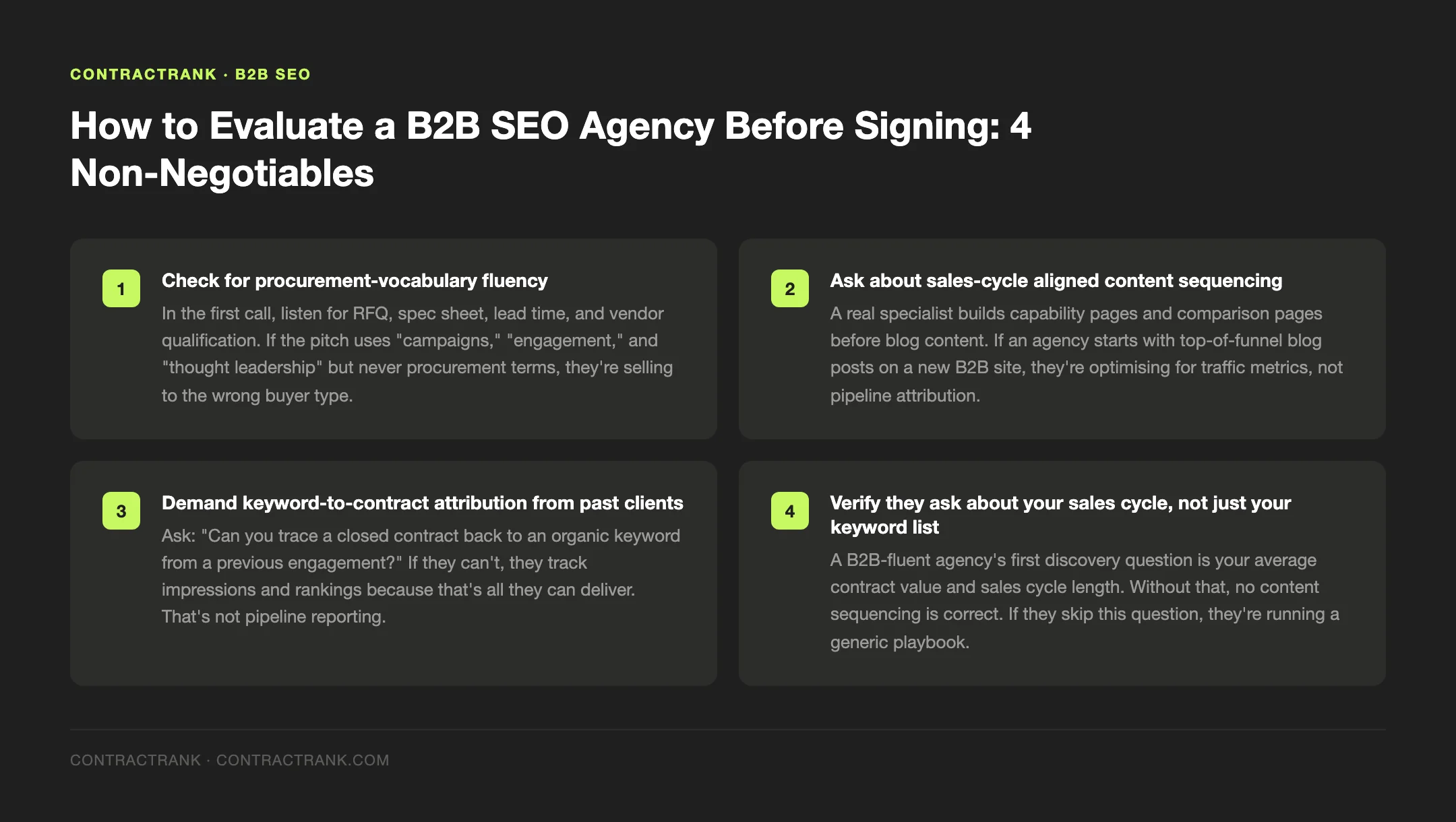
1. Industry vocabulary fluency. Can they pronounce “RFQ,” “spec sheet,” “capacity utilization,” and “lead time” without prompting? If the discovery call uses “campaigns” and “engagement” but never mentions “purchase orders” or “vendor qualification,” they don’t speak your buyer’s language.
2. Procurement-search keyword expertise. Gartner research shows 83% of a B2B purchase happens before the buyer contacts a vendor. They’re searching during that 83%. The keywords are commercial-intent (“[capability] manufacturer near [region],” “[material] [process] vendor for [industry]”), not informational (“what is industrial fabrication”). An agency that pitches “we’ll target high-volume keywords” is targeting the wrong queries entirely.
3. Sales-cycle aligned content. B2B buyers move from awareness through evaluation to decision over months. Each stage needs different content. A specialist builds bottom-of-funnel content (capability pages, comparison pages, RFQ landing pages) before adding top-of-funnel blog content. Generalists do it backwards: traffic first, conversion never.
4. Pipeline attribution capability. Can they trace a contract back to an organic keyword? Most can’t. They report on traffic, impressions, and rankings because those numbers exist by default. A specialist sets up GA4 conversion tracking, CRM-source mapping, and (where possible) call tracking. If they can’t say “this $80K contract started at this query” within 6 months of starting, they’re not measuring what matters.
5. Bottom-of-funnel page focus. LinkedIn’s B2B Institute and Ehrenberg-Bass research finds that ~95% of B2B buyers are out-of-market at any given moment. The 5% in-market right now are searching for “[capability] vendor” and “[product] for [application]” queries. Capability pages and comparison pages convert. Listicle blog posts don’t, for non-tech B2B.
6. Account-based content layering. If the agency knows your top 50 target accounts, they can build content that pulls those specific accounts into your funnel. Industry-specific case studies, integration pages for the systems those accounts use, content that addresses the procurement criteria those accounts publish. Generic content can’t do that.
7. Transparent reporting and pricing. Most B2B SEO agencies hide pricing behind discovery calls and report on impressions and rankings instead of attributed pipeline. A specialist publishes pricing, reports on contracts attributed to organic, and tells you when the strategy isn’t working before you ask. We covered the pricing benchmarks for B2B SEO separately.
Red flags specific to B2B buyer evaluation
Five tests you can run on any agency in the first conversation:
| Red flag | What it tells you |
|---|---|
| All case studies are B2B SaaS | They learned B2B on freemium funnels. Your sales motion isn’t theirs. |
| Pitch focuses on “thought leadership” content | Thought leadership ranks for awareness queries. Awareness traffic doesn’t convert in 90-180 day cycles. |
| Won’t show keyword-to-contract attribution from a past client | They don’t measure it because they can’t deliver it. |
| Quotes you a price after a 30-min call without seeing your site | Price is based on what they think you’ll pay, not what the work costs. |
| Service area is a single US city | Local digital agencies optimise for local lead gen, not national B2B. |
For a deeper look at what separates B2B SEO specialists from generalists, see our B2B SEO experts hiring guide.
What a proper B2B SEO discovery call looks like
A B2B-fluent agency will ask, in the first call, three questions a generalist never asks:
- “What’s the average contract value and sales cycle length?” Without this, no SEO strategy is targeting the right keywords. A 6-month sales cycle changes everything about content sequencing.
- “What are your top 10 active and target accounts?” If they’re going to support account-based content, they need this. If they don’t ask, they’re not.
- “Who’s actually searching for you, and what’s their job title at the moment of search?” Procurement manager? Plant manager? VP Operations? Each searches differently. The keyword strategy follows from this answer.
If the discovery call is mostly the agency talking about their methodology, you’re hearing a sales pitch, not an evaluation.
How ContractRank works
ContractRank works exclusively with non-tech B2B companies in manufacturing, logistics, professional services, and industrial verticals. Pricing is $750/month, published on the homepage with no discovery call required to get a number. Every engagement starts with capability-page audits and procurement-keyword mapping before a single blog post is written. The full scope is in the B2B SEO guide, and content strategy specifics are in B2B content strategy.
FAQ
What makes a B2B SEO agency actually good? A good B2B SEO agency speaks your buyer’s procurement vocabulary, builds bottom-of-funnel content (capability pages, comparison pages) before blog content, attributes contracts to organic keywords in reporting, and aligns content sequencing to your sales cycle length. Most agencies do none of this, which is why most engagements don’t produce contracts.
How much should a B2B SEO agency cost? Specialist B2B SEO ranges from $750/month (productized, published pricing) to $15,000/month (large traditional agencies). Mid-range $3,000-$8,000/month is most common for B2B SaaS. Non-tech B2B has fewer specialist options at any price point. Productized models compress this gap.
How long does B2B SEO take to show pipeline? Low-competition commercial keywords rank in 60-90 days. Add your sales cycle on top. For a manufacturing or industrial business with a 90-180 day sales cycle, the first SEO-attributed contract typically lands 6-9 months after starting. Earlier rankings are possible. Earlier contracts depend on cycle length, not SEO speed.
Why don’t most B2B SEO agencies work for non-tech B2B? Most agencies’ B2B experience is B2B SaaS. The SaaS playbook (product-led content, integration pages, freemium funnels, 14-day trials) doesn’t translate to manufacturing, logistics, or industrial buyers who research over weeks, evaluate via RFQ, and contract in 90-180 days. Non-tech B2B needs procurement-intent keyword strategy and capability-page content. Most agencies don’t build that.
If your B2B site is producing reports but not contracts, the gap is usually strategic, not tactical. See if ContractRank is the right fit for your business.

I've spent 11+ years working in B2B marketing across SaaS, ecommerce, and technology. I've helped companies climb to page-1 positions on Google and grow organic traffic significantly across multiple B2B categories. Most SEO focuses on traffic. But B2B growth doesn't come from traffic alone. It comes from showing up when real buyers are searching. ContractRank was built around that idea.